The British government has long been keen on encouraging the prospect of what were initially known as ‘connected and autonomous vehicles’ (CAV). In 2015 it set up the Centre for Connected and Autonomous Vehicles to stimulate the development of the technology and steered funds into the sector via the Transport Systems Catapult. Typical of recent bullish statements by DfT ministers is this from Grant Shapps, when Transport Secretary, earlier this year:

‘The benefits of self-driving vehicles have the potential to be huge. Not only can they improve people’s access to education and other vital services, but the industry itself can create tens of thousands of job opportunities throughout the country. Most importantly, they’re expected to make our roads safer by reducing the dangers of driver error in road collisions. We want the UK to be at the forefront of developing and using this fantastic technology, and that is why we are investing millions in vital research into safety and setting the legislation to ensure we gain the full benefits that this technology promises.’

There’s no doubting the enthusiasm, but is this just hype, or is there a reality underpinning the vision? And what exactly is the vision anyway? It seems to be principally focussed on re-imagining the existing private car as a vehicle that no longer needs a driver behind the wheel, and which can whizz its occupants around in robotic mode, avoiding collisions and improving safety, whilst allowing the passengers to get on with other tasks, or simply enjoying the ride and the view – or maybe having a nap.

Trials of such driverless cars on public roads are taking place in a number of countries, mostly with a human ‘safety driver’ still on board, but this requirement has been dropped in some US and Chinese locations where traffic conditions are deemed favourable. Yet the prospects remain uncertain, so it is timely that the House of Commons Transport Committee has initiated an inquiry into self-driving vehicles.

I am specifically exploring here the prospects for such driverless cars ever becoming widespread, acceptable and effective in the foreseeable future. I’m not considering the possibilities of driverless multi-user pods or rapid transit buses on at least semi-segregated roads, where some deployment has already taken place. Nor do I discuss the scope for freight vehicles to operate in platoons on inter-urban motorways, where a recent UK trial found the hoped-for improvements in fuel use to be disappointing.

The government published a substantial policy document in August of this year entitled Connected and Automated Mobility 2025, jointly presented to Parliament by the Secretary of State for Transport and the Secretary of State for Business, Energy and Industrial Strategy.

Note that Automated has replaced Autonomous, perhaps reflecting a scaling down of expectation. Note also that Mobility has replaced Vehicles, hence CAM rather than CAV, a sensible but small generalisation. But note also the absence of reference to Connected within the new document: the whole emphasis is on automation of individual vehicles, with little mention of the possibilities of connectedness between vehicles. In this, the government is following the prevailing mindset of the automotive industry, tech start-ups as well as established vehicle manufacturers, who see autonomy easier to achieve than connectedness between vehicles of different manufacture and type.

The self-driving vehicle concept is seen as the application of CAM technologies with greatest commercial potential. But for deployment to happen, safety must be assured. So in 2018 the government asked the Law Commission to develop the legislative framework for a safety regime. The Commission’s final report, also published earlier this year, will be the basis of legislation that the DfT will bring forward.

Legal consequences

Because, to be useful, a self-driving vehicle will need to be able to drive itself for at least part of a journey, there are profound legal consequences. The human driver can no longer be the principal focus of accountability for road safety. Instead, new systems of safety assurance are needed, both before and after vehicles are allowed to drive themselves on roads. The legal framework has to cover both self-driving functions, where a user must be able to take over control when the vehicle cannot cope – for instance in poor visibility-  as well as more advanced automation when the vehicle is able to cope under all conditions.

The Law Commission proposes three new legal actors:

  • Authorised Self-Driving Entity (ASDE) – the vehicle manufacturer or software developer who puts a self-driving vehicle forward for authorisation to the regulator.
  • User-in-charge (UiC) – the human in the driving seat while the vehicle is driving itself, who can take charge if the self-driving function cannot cope.
  • NUiC operator, a supervisory system responsible when there is no user in charge, to navigate obstructions and deal with incidents.

There will need to be regulators for new functions:

  • Vehicle type approval.
  • Authorisation to self-drive.
  • In-use safety regulation.
  • NUiC operator licencing.

The proposals of the Law Commission will need to be enacted in legislation, to make possible the government’s intention to make the UK an attractive place for the deployment of self-driving vehicles, even though the main development of the technology is taking place in the US, where there is considerable diversity of regulatory regimes across the states. However, the comprehensive legal framework may deter some prospective developers.

Ride-hailing operators such as Uber, who have aspirations for a driverless future, might hope to save the costs of the driver. But under the proposed regime they would need to own the vehicles and accept responsibility as the NUiC operator for oversight of operations, and possibly also to be the ASDE. This would be a large and costly change from the company’s current capital-light business model, where ownership of the vehicles lies elsewhere.

Electric vehicle maker Tesla’s approach to automation has meanwhile been to incorporate the hardware into existing privately-owned vehicles and to progressively improve the software over time to get to the point of implementing what is being marketed as ‘Full Self-Driving’ capability. Taken literally, this would also require Tesla to be licenced as a NUiC operator, with oversight of its whole fleet of vehicles on the road, which is hardly conceivable. So if they use the automated mode, Tesla drivers would need always to stay alert and be prepared to take charge in the event of the unexpected.

Safety

A key question in this discussion is the appropriate level of safety required for a self-driving vehicle. The Law Commission took the view that this is best decided by ministers, in the light of judgement of the public’s acceptance of risk. The view of the government, set out in the recent policy document, is that self-driving vehicles should be held to the same standard of behaviour as that expected in road traffic legislation for human drivers: ‘competent and careful’. This standard is higher than that generally enforceable now on the average human driver – who include, for example, drivers who are fatigued, distracted or under the influence of drink or drugs- despite this not being the behaviour that is expected of them.

The ‘competent and careful’ standard appears to be the minimum required politically. Anything less would hardly be publicly acceptable. But does it do the trick? On occasion, self-driving vehicles will inevitably be involved in crashes with fatalities. ‘Competent and careful’ implies that the self-driving vehicle could not be blamed. The fault would be attributed to the other drivers (‘human error’) or to vehicle- or road-related defects. Yet would it be possible to demonstrate such blamelessness in practice, when the other parties to the crash would be seeking to shift responsibility?

In Britain there is one fatality per 140 million miles driven, so deaths involving self-driving vehicles could be expected to be exceedingly rare events. But when they do occur, they will surely  attract much public attention. As a result, there may well be pressure to tighten safety standards further, which, done in response to public anxiety, may undermine the general acceptability of self-driving vehicles. There is therefore a good case for a higher initial safety standard than ‘competent and careful’ to be set.

Benefits

The practical development of vehicle automation for general deployment is proving more difficult than the pioneering technology optimists had hoped. Apart from getting the technology to the point of being publicly acceptable, there is an evident need to develop viable business models consistent with the expected regulatory regime. And that means asking who will buy the vehicles? This in turn will depend on how purchasers perceive the benefits. In this regard, the practical benefits of vehicle automation remain unclear.

Proponents point up the safety benefits, especially in the United States where almost 39,000 people were killed in motor vehicle crashes in 2020, a fatality rate of 12 per 100,00 population, compared with 2.3 for the UK. Given that human error and risky behaviour is said to be responsible for 90% or more of fatalities, it would seem a reasonable expectation that the ‘robot driver’ of a self-driving vehicle could do better than fallible humans. On the other hand, robots suffer from their own shortcomings, tending to be less effective at perceptions involving high variability or alternative interpretations. In particular, robots would find it difficult to engage in the kind of visual negotiation that occurs between human drivers to settle which gives way when space is tight. Besides, the driving performance of a robot would need to be very similar- or better- than that of a human driver to ensure public acceptability. A self-driving vehicle that proceeded particularly cautiously to meet safety requirements could be unattractive to the purchasers, and an irritation to other road users . So the robot driver would effectively need to learn how to drive like a human.

Another claimed benefit is that automation might increase the capacity of existing roads by allowing these safety-conscious vehicles to move with shorter headways, that is, with a smaller distance between them than the recommended two-second gap on fast roads. The more precise control exercised by a robot might also smooth traffic flows and allow the use of narrower lanes. However, such increases in capacity would seem likely to be possible only on roads dedicated to self-driving vehicles, since the presence of conventional vehicles, not to mention cyclists, motorcycles and pedestrians, would require standard spacing to be maintained. In any event, in line with current experience, any increase in capacity would be expected to attract additional traffic, so that long term congestion relief would not be expected.

Automation that allowed an increase in road capacity might anyway be of interest to a road authority, as a public benefit, but not to individual vehicle owners if they had to bear the cost of the necessary technology. Because self-driving vehicles would be capable of operating empty, for example when returning to base after dropping off the occupant, and thus not needing to pay to park, they could add to the traffic miles generated and hence to congestion. Conventional taxis operate without a passenger while seeking a fare, of course, but privately owned vehicles without occupants would be a new source of traffic. All this is before any consideration of how they would be licenced and the fee, and/or any road user charges they must pay- whether the same as, or different to, conventionally driven vehicles.

Prospects

One obvious problem of driverless vehicles is how they can happily enter the vehicle population alongside conventionally-driven vehicles The prospects for widespread vehicle automation on existing roads with mixed traffic seem very uncertain. The driving task on motorways might be lessened in good visibility and in the absence of road works, but the driver would need to be immediately available to take control in adverse situations – and when going into general traffic. There are some low-speed environments that might accommodate driverless vehicles, including campuses, business parks and other new developments with extensive road space, and some such deployment has taken place; in these circumstances driverless shared-use pods could be a cost-effective transport technology. Yet it is hard to see driverless vehicles successfully negotiating historic towns and cities with complex road layouts, often narrow streets, extensive kerbside parked cars, cyclists and randomly moving pedestrians.

This impediment to automation in general traffic in urban areas is particularly relevant to the idea of driverless taxis that could be attractive to ride-hailing operators such as Uber, to avoid the cost of the human driver and spread the extra capital cost of the vehicle through intensive use. On the other hand, there would be the potential cost of ownership of fleets of automated taxis, rather than the current model of ride-hailing operators where drivers own their own vehicles. Besides, a driverless taxi system operator would need to exercise oversight of the activity of each vehicle in their fleet, to deal remotely with incidents and navigate obstructions, which would add to costs. It is certainly possible that the relatively unskilled human taxi driver in their own car may remain a lower cost option than the robot driver in a specially provided one.

The way forward thus remains unclear. Indeed, after more than a decade of development of autonomous vehicles, the early excitement and optimism have been followed by some disillusion as the problems of achieving and implementing an acceptably safe product have been recognised. The recent decline in the value of technology stocks and venture capital investments suggests that finance to support further development of vehicle automation may be harder to come by. Indeed, Argo, an autonomous vehicle tech start up funded by Ford and VW, is shutting down, evidence of uncertain prospects for the technology. Accordingly, it would be premature to predict the eventual outcome, both in timing and extent of deployment. Who can judge whether, as enthusiasts for the technology assert, children born today will not need to learn to drive a car?

The major transport innovations of the past have been those that made possible step-change increases in the speed of travel – the railway and the modern bicycle in the nineteenth century, the internal combustion engine for road vehicles and the jet engine for aircraft in the twentieth century. These step-change increases in speed, and thus reductions in journey times, permitted increased access to people and places, opportunities and choices, which were the benefits of harnessing the energy of fossil fuels for the motive power of mobility. In contrast, it is unlikely that automation would increase the average speed of travel on the existing road network, which is constrained by safety and congestion. Accordingly, the benefits of vehicle automation are much more likely to take the form of improved journey quality, and hopefully safety, and the possibility of doing other things whilst on the move – particularly those that have come with the digital information and communications era . It remains to be seen to what extent purchasers of driverless vehicles will be willing to pay for these benefits – or if they can achieve them by adapting to wider new mobility thinking in other ways, particularly at a time of changing inter-generational attitudes to the ownership of vehicles personally, and their use.

The UK government has been very supportive of vehicle automation, in particular aiming to put in place a comprehensive legislative regime based on the thorough analysis by the Law Commission. Yet there is only limited commercial development of the technology underway in Britain, so the benefits for both industrial and transport policy do not seem to be that great. A more important technology priority for road transport policy has surely to be the switch to electric propulsion and the quest for transport decarbonisation.

This blog is the basis for an article in Local Transport Today dated 14 November 2022.

I made a presentation to the Highways UK Conference held at Birmingham 2-3 November 2022. These are the main points.

The widespread use of Digital Navigation (DN) (generally known as satnav) is changing travel behaviour (see my recent paper). One impact is to divert local users to major roads to take advantage of increased capacity. I have analysed two Smart Motorway investments in detail: M25 Junctions 23-27 and M1 Junctions 10-13. The Smart Motorway concept involves converting the hard shoulder to a running lane, originally during the periods of morning and evening peak demand, or, as has been recent practice, throughout the day. The advantage is that capacity can be increased without the cost of additional land take or rebuilding bridges.

Monitoring the traffic flows and speeds 3-5 years after opening of the two schemes showed that the forecast increases in speed had not occurred, and hence the economic benefits, which largely depend on the value of time savings, were not obtained. Something had gone badly wrong with the traffic modelling that informed the investment decisions. Accordingly, I sought and obtained copies of the relevant reports.

The traffic modelling in both cases employed regional variable demand models that utilised the long established SATURN software. Traffic flows and speeds for the with- and without-investment cases were compared, and the outputs fed into the economic model, the Department for Transport’s TUBA model, which forecasts the economic benefits. In both cases, substantial travel time saving benefits were projected for business users, offset by a small increase in vehicle operating costs (VOC). There were also substantial time savings for non-business users (commuters and others) but these were very largely or entirely offset by increased VOC. Hence there was no net economic benefit to non-business users. It seems likely that increased number such users, above that forecast, pre-empted the increased capacity intended for longer-distance business users.

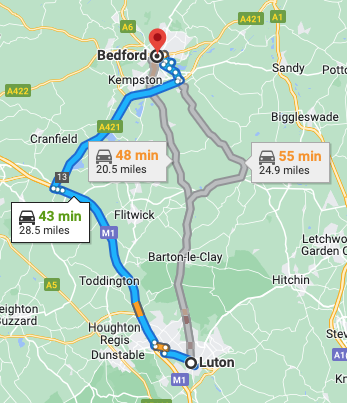
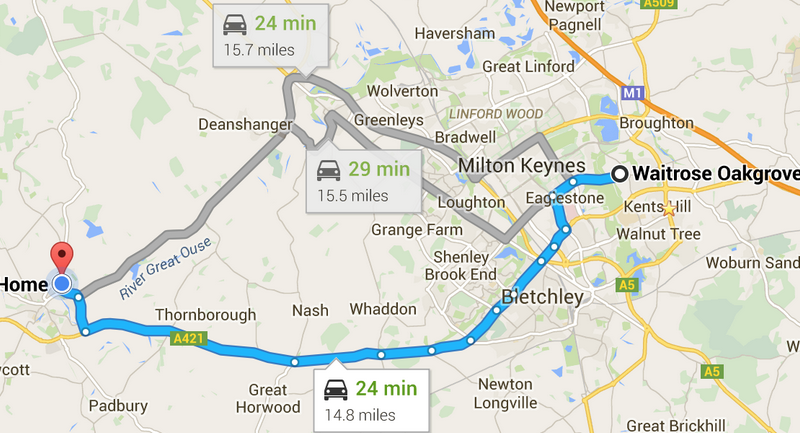
Examination of the routing information offered by Google Maps, for a journey between two locations in the neighbourhood of a Smart Motorway scheme, shows that diversion to the motorway can save time, but at the cost of increased distance and hence fuel cost (see screenshot at top). This is consistent with the modelling, on the basis that road users are likely to take the faster route and be less concerned about VOC.

Those making local trips have a variety of options, using the motorway as well as local roads, while long-distance users are likely to stay on the motorway. In the past, local users would have made routing decisions based on recent experience of congestion and  broadcast traffic information. But with the widespread use of DN, the choice of the fastest route is clear. The impact of DN is to increase local use of motorway capacity, to the disadvantage of longer-distance users. This seems likely to be an important contributory factor to the failure of the M25 and M1 Smart Motorway investments to deliver the expected travel time savings.

Although detailed information is available only for two Smart Motorway schemes thus far, it is likely that these may not be unrepresentative. The Strategic Road Network (SRN) is under greatest stress in or near areas of population density, where local users and longer-distance users compete for road space. Remote from such areas, the traffic generally flows fairly freely. So opportunities for investment appear to be where local users are best placed to take advantage of new capacity.

If the motorway system operated as a toll road, as in France or Italy, tolls would deter use by locals. The one example in the UK is the M6 Toll road in the West Midlands, built and operated with private finance, where daily traffic is half that on the adjacent M6 proper, doubtless due in part to the toll that local users do not choose to pay. But this is the exception that proves the rule: which is that attempts to alleviate congestion by increasing the capacity of major roads experiencing marked peaks of traffic at commuting times, as with Smart Motorways, must be expected to result in increased use for local trips, to the disadvantage of longer-distance users.

To better appreciate the benefits of road investment, it would be important to understand the impact of DN on road user behaviour, so that this can be incorporated into the traffic modelling that informs investment decisions. It would also be important to get a more granular evaluation of outcomes of investment. Traffic and economic modelling of prospective investments distinguishes between business and non-business users, the former split between cars, light goods and heavy goods vehicles, and the latter between commuter and other journey purposes. In contrast, monitoring of outcomes only tracks total traffic, volume and speed. However, it is now possible to employ DN to distinguish between local and longest-distance traffic, as exemplified by the TomTom Origin/Destination analytical service. Making such a distinction is important for evaluating the economic benefits of investment since the total volume of traffic might be close to that forecast, but if the share of local users is greater than forecast, the economic benefit will be less than expected.

We are at present midway through the second five-year road investment programme, known as RIS2, worth £27bn over the period 2020-2025. RIS3 is now being planned. But there are headwinds:

  • The potential economic benefits are likely to be overstated, as discussed above.
  • Any increase in road capacity is inconsistent with the Net Zero climate change objective since both tailpipe and embedded carbon would be increased.
  • There are public anxieties about the safety of Smart Motorways in the absence of the hard shoulder, reflected in a critical report from the House of Commons Transport Committee, to which the government responded by halting new schemes until five years of safety data is available.
  • The government’s Levelling Up White Paper, published in early 2022, identified a dozen ‘missions’ across departments. The single mission for the Department for Transport is aimed at improving public transport in regional cities towards that achieved in London, a sensible political and social objective. There was no reference to road investment, which is sensible given that congestion delays on the SRN are less in the Midlands and North than in the South East.
  • Current pressures on medium term public expenditure.

Given these impediments, there is a good case for treating the SRN as a mature network, with a focus on operational efficiency. This is the case for urban roads, which in the past were enlarged to accommodate more traffic, but nowadays the trend is to reduce capacity allocated to general traffic, to encourage active travel and facilitate public transport. Similarly, the aviation sector focuses on operational efficiency – airlines maximising use of aircraft, allocated routes and passenger load factors; airports (struggling recently) optimising throughput of passengers and baggage; and air traffic managment making best use of crowded airspace. The underlying discipline is operations research, not civil engineering, plus the modelling and economic analysis of operations, not long-lived investment.

A focus on operational efficiency of the SRN would naturally prompt consideration of how best to take advantage of the huge investment in DN that has been made, both by providers of the service and by road users. Here a very odd phenomenon is the apparent disregard of DN by road authorities, at least a judged by their publications – no reference to satnav in those of National highways, the Department for Transport, or local authorities (with the one exception known to me, Transport for London’s collaboration with Waze). Why is this? Possibly because of the preoccupation of highways engineers with civil engineering works, the need to spend the large budget allocated to the SRN, the lack of professional background to cope with digital technologies, and that fact that road authorities are monopolies, so not subject to competitive pressures?

The one constituent of road users that is highly competitive is road freight, particularly that forming part of integrated logistics businesses, which makes extensive use of digital technologies to manage fleets on the SRN and delivery vehicles on local roads. We are well aware of this when we order goods online, with a specified delivery date and often a time slot, the ability to track packages, delivery confirmed on the doorstep, and our feedback sought on the experience – all done by algorithm. This kind of operational efficiency needs to be brought to bear on the totality of traffic on the road network.

Experienced network operators would naturally want to take advantage of DN, which is vehicle-to-infrastructure connectivity that is changing travel behaviour on a massive scale. One aim would be better to cope at times of stress – major incidents, bad weather, peak holiday flows. A second would be to optimise use of the network in normal times, including avoiding routing traffic through unsuitable minor roads.

There is a maxim that you can’t build your way out of congestion, which we know from experience to be generally true. The Smart Motorway case studies exemplify this truth and provide an explanation: increased capacity is taken up by local users, pre-empting capacity intended for longer-distance business users, with no overall economic benefit, and restoring congestion to what it had been before. However, when road users are asked why congestion is a problem, their main concern is the uncertainty of journey time. Digital Navigation provides estimates of journey time in advance, so those who need to be at their destination at a particular time can decide when best to set out; those who are more flexible can avoid the worst of congestion; and all can choose the fastest route.

Digital Navigation is vastly more cost-effective as a means to mitigate the impact of road traffic congestion than costly civil engineering investment.

I have previously drawn attention to the impact of Digital Navigation (DN) of travel behaviour. The providers of this service, commonly known as satnav, respond to requests from users by providing routing options and journey times that take account of prevailing traffic conditions. Here I want to consider how this is achieved.

There is only fragmentary published information on how the routing algorithms function. It appears that a model of travel behaviour on the road network is constructed from trip data derived from users of the navigation service: trip origins, destinations, routes through the network, time of day/week, prevailing traffic conditions, journey times. Such a model may be analogous to a microsimulation model, but using observed trip data rather than synthetic data. It could also be viewed as combining the trip generation, distribution and assignment stages of the standard four-stage transport model (the mode split stage not being relevant for committed road users seeking routing advice).

Providers of DN offer predictions of journey time in advance of setting out. Comparison of predicted and outturn journey times provides a check on the validity of the model. Machine Learning has been employed to improve the accuracy of journey time predictions of Google Maps.

The type of model developed by DN providers is novel and powerful in that it can utilise huge amounts of trip data, both real time and historic. A question is whether such models could be used to inform decisions on road investments and other interventions aimed at improving experience on the road network. That is, could the DN models replace conventional transport models for planning purposes?

The DN models already exist. Their cost of construction and operation is met by the income generated from sales, whether of direction services to business premises (e.g. Google Maps) or to vehicle manufacturers that fit DN as standard equipment (e.g. TomTom). So, the cost of using these models for planning purposes could be less than for building and using conventional models.

TomTom offers Origin Destination Analysis as a service and may therefore be open to suggestions for use of the underlying model for planning purposes.

Another possibility would be to create an open-source, crowd-funded DN model – a kind of not-for-profit version of Waze, a provider that encourages user input. The funders might be road authorities that would gain access the the underlying model for planning purposes.

A further possibility arises from the likelihood that some form of electronic road user charging will be introduced, as electric propulsion replaces the internal combustion engine, to replace revenue from fuel duty. This is likely to involve technology similar to DN, and might therefore be the basis of traffic modelling for other purposes.

DN is both changing travel behaviour and generating new travel models to inform public policy. We may be at the beginning of a new era of travel and transport analysis.

I post a blog a few months ago about the Office of Rail and Road (ORR), which was consulting on its involvement in the third road investment strategy (RIS3). The outcome of this consultation was recently announced.

I had responded to the consultation, suggesting that the ORR should take an interest in the benefits of road investment as experienced by road users, since there was doubt about who mainly benefited, local users (commuters and others) or business users. My contribution was published by the ORR, anonymously, as ‘Response from member of the public D’ (I would have been happy to be named, but was not asked).

In its detailed response to the consultation, the ORR responded to my suggestion at paragraph 3.7, saying that it is not within its remit. It is unusual for an industry regulator to take no interest in the consumer experience. This is a central concern for the regulators of other industries – energy, water, telecoms, financial services.

The ORR also ducked out of accepting other suggestions for extending its responsibilities, including in relation to other important government objectives such as Net Zero and Levelling Up. The detailed critique of the Transport Action Network (page 78 of the ORR response document) is well worth reading.

Altogether, the ORR is a pretty feeble regulator in respect of roads.

The House of Lords Built Environment Committee is carrying out an inquiry into public transport in towns and cities. I was invited to submit written evidence, which is now published.

My conclusions:

For public transport in towns and cities to be improved, the share of car travel needs to be reduced, to lessen both competition for passengers and road traffic congestion.


To reduce car use, better public transport is needed, which requires both local government to take overall charge of services and to have a sustainable source of funding beyond the farebox.


There are no new technologies that will make much difference.

I have a new article published in a peer reviewed journal:

Metz D. The impact of digital navigation on travel behaviour. UCL Open: Environment. 2022;(4):05. https://doi.org/10.14324/111.444/ucloe.000034

Abstract

Digital navigation – the combined use of satellite positioning, digital mapping and route guidance – is in wide use for road travel yet its impact is little understood. Evidence is emerging of significant changes in use of the road network, including diversion of local trips to take advantage of new capacity on strategic roads, and increased use of minor roads. These have problematic implications for investment decisions and for the management of the network. However, the ability of digital navigation to predict estimated time of arrival under expected traffic conditions is a welcome means of mitigating journey time uncertainty, which is one of the undesirable consequences of road traffic congestion. There is very little available information about the impact of digital navigation on travel behaviour, a situation that needs to be remedied to enhance the efficiency of road network operation.

An article in Local Transport Today of 13 June broadens the consideration.

The Department for Transport (DfT) has started planning its third Road Investment Strategy (RIS3), a five-year investment programme for the Strategic Road Network (SRN) for the period 2025-2030. The approach is conventional – a programme of projects, with little overview of how societal objectives will be advanced by the likely substantial expenditure. Yet there are five major issues that need to be addressed for the programme as a whole.

First, there is a need to reconcile the government’s Net Zero objective with the carbon emissions from both the tailpipes of the additional traffic arising from increased road capacity and the embedded carbon in the cement, steel and asphalt used in construction. Recent presentations by the DfT’s Transport Appraisal and Strategic Modelling (TASM) division indicated an intention to tackle this issue at scheme level, but this is misconceived. What matters is the overall contribution of RIS3 to carbon emissions and how this is to be offset or otherwise justified.

Second is the question of how RIS3 advances the government’s Levelling Up agenda, where the recent, well-received White Paper identified twelve medium-term ‘missions’ to be pursued across all departments. The one specific to transport states: ‘By 2030, local public transport connectivity across the country will be significantly closer to the standards of London, with improved services, simpler fares and integrated ticketing.’ Although the rate of progress implicit in ‘significantly closer’ is vague, the direction of travel is clear and the objective is not in dispute.

There is no mention of investment in the SRN in the Levelling Up White Paper. This is appropriate since there is, if anything, an inverse relation between the performance of the road network and economic prosperity across the nation, given that delays on the SRN due to congestion are greater in London and the South East than in other regions of England.

The implication of the White Paper approach is that there should be a substantial switch of DfT funds from road investment to improve public transport beyond London, if the Department is to play a full role in supporting the government’s the Levelling Up agenda. Yet the Department’s recently issued Levelling Up Toolkit is essentially a pro forma for a box-ticking exercise aimed at justifying investments already forming part of agreed expenditure programmes. There is palpable inconsistency here.

Third, we have the problem of the safety of smart motorways. These require conversion of the hard shoulder to a running lane as an economical means of increasing capacity without the expense of rebuilding bridges. Generally, new roads are safer than older roads, which meant that adding road capacity yields a modest safety benefit. But this is not obviously the case for smart motorways, and there has been considerable pushback from the public and the House of Commons Transport Committee. As a result, the DfT has paused the roll out of new smart motorways until five years of safety data is available for schemes introduced before 2020. A decision on the generic safety of smart motorways will be an important factor in developing RIS3.

Fourth, and less recognised, there is a question about the economic benefits from additional road capacity. There are two published evaluations of smart motorway schemes where the traffic flows after opening were very different from those that had been forecast. For the M25 Junctions 23-27 scheme, the traffic flowed faster one year after opening but subsequently delays reverted to what they had been before opening on account of greater traffic volumes than forecast. For the M1 J10-13 scheme, traffic speeds five years after opening were lower than before opening. Since the main economic benefit of road widening is the saving of travel time, both schemes had negative benefit-cost ratios (BCR) at outturn.

Examination of the reports of the traffic and economic modelling of these two schemes showed substantial time-saving benefits expected for business users, offset by a small amount of increased vehicle operating costs (VOC) arising from additional traffic volumes. There were also time savings to non-business users (for commuting and other local travel) but these were entirely offset by increased VOC – because these were local trips that rerouted to the motorway to save a few minutes of time, at the expense of additional fuel costs.

The scope for rerouting local trips to take advantage of increased motorway capacity is likely to be underestimated in modelling. Local users have the flexibility to vary routes whereas long distance business users will stay on the motorway unless there is a major holdup. Moreover, the general use of digital navigation in the form of Google Maps and similar offerings makes choice of minimum time options commonplace.

Even when the outturn total traffic flows are a reasonable match to those forecast, the scheme economics could be much worse than predicted if there is more local traffic, and hence less long distance business traffic, than projected. Traffic and economic modelling involve recognition of different classes of road user with different values of travel time: cars, LGVs, HGVs, business, local commuters, and other local users. However, the monitoring of outturn traffic flows does not distinguish between these classes of users. GPS tracking make such distinctions possible.

The DfT has emphasised the importance of evaluation of outturns of investments. Yet the failure to appreciate the need to break total traffic flows down into the segments that had been modelled reflects a serious professional shortcoming. As a result, we cannot be at all confident that investments to increase SRN capacity do more than facilitate rerouting of short trips by local users, of nil economic value. Likewise, we do not have the kind of detailed evaluation data that would allow traffic models to be better calibrated for future use.

The fifth issue for RIS3 is that the widespread use of digital navigation by drivers prompts questions about the continued focus of DfT and National Highways on major civil engineering expenditure. Contrast the aviation sector, where new runways or terminals are occasional efforts, not regular business. The main focus of airlines and air traffic control is to improve operational efficiency, to sweat the assets employing the techniques of operational research. We have a mature road network in Britain. It’s time to focus on operational efficiency. Yet it seems not to occur the National Highways that working with Google Maps, TomTom and other providers of digital navigation services would be a cost-effective means of improving the performance of the network.

More generally, the DfT is trapped in its box labelled Transport Analysis Guidance (TAG), a thousand pages of prescription to which more text is added when some new issue or policy arises, such as Net Zero, Levelling Up, inequalities or gender. The task for those promoting a scheme is to tick all the boxes and flex the modelling to generate BCRs that represent good value for money. Evaluation of outturns is inadequate to distinguish between success and failure.

Although the DfT pays lip service to the need to think at the strategic level, the TAG framework does not facilitate this in that the detailed analysis is at project level. Other interested parties do not challenge the Department’s approach. The consultants and local authorities do not bite the hand that feeds them. The professional societies, institutions and think-tanks do not engage. The National Audit Office carries out good analysis of road investments on occasion, but not systematically. The Office for Rail and Road scrutinises the management of the SRN, including how well new investments are delivered, but does not see its role as enquiring into how investments benefit road users. This is quite unlike the regulators of other infrastructure industries – electricity, gas, water, telecoms – that are focused on how consumers benefit from investment.

The DfT is stuck in its box and seems unlikely to break out. The best bet for a strategic view of RIS3 may come from the National Infrastructure Commission, which has begun the development of its second National Infrastructure Assessment. The Commission’s advice was the basis of the government’s £96 billion rail investment programme for the North and the Midlands. This required fresh thinking about the benefits of transport investment at the level of the whole programme, an approach clearly needed for RIS3.

This blog post formed the basis of an article in Local Transport Today of 25 March 2022.

The House of Lords Environment Committee is carrying out an inquiry into public transport in towns and cities. I was asked to provide a submission, as follows.

The scope for public transport in cities and towns depends importantly on the level of car use, both because the car competes for passengers and because car traffic impedes the progress of buses, lessening their attractiveness.

The car is the dominant means of travel in Britain and other developed economies. It offers efficient door-to-door travel over short to moderate distances where traffic congestion does not lead to unacceptable delays and where parking is available at both ends of the journey. Public transport does not offer an attractive alternative to most car drivers in these circumstances. However, in urban areas where congestion causes delays and where parking is costly and limited, alternatives to car travel become attractive. To grow public transport use in towns and cities, it is necessary both to improve bus and rail services and constrain car use.

Urban travel and traffic

It is necessary to recognise that our availability of time always constrains the amount we can travel. There are many activities that we need to fit into the 24 hours of the day, and on average we spend just an hour on the move. This limits the build-up of road traffic congestion, which arises in areas of high population density and high car ownership where there is not enough road space for all the car trips that might be made. If traffic volumes grow for any reason, delays increase and some potential car users make other choices. We may change the timing or route of a car journey, or the travel mode where there are alternatives available, or a different destination such as an alternative shopping centre, or not to travel at all, for instance by shopping online.

Road traffic congestion is therefore self-limiting. We know from experience that we cannot build our way out of congestion by adding road capacity, since this allows previously suppressed car journeys to emerge, restoring congestion to the previous level. Conversely, if urban road space is taken away from cars in order to create bus or cycle lanes, then initially congestion will increase. But the additional delays will induce some car drivers to make alternative choices and congestion will revert to what it had been. The overall impact of reducing urban road space is to reduce the share of journeys by car.

Accordingly, it is difficult to reduce the intensity of traffic congestion, but it is possible to reduce the amount of congested traffic by reducing road space available to general traffic, which can be publicly acceptable if alternatives to the car are provided. This is what has been happening in London over many years, as the population has grown, as there has been large investment in public transport, and as there has been a reduction in road space available for cars. Private transport use fell from 48% of all trips in 2000 to 37% in 2019, while public transport use grew from 27% to 36% over the same period. Cycling increased from 1.2% to 2.4% while walking held steady at 25%. The London Mayor’s transport strategy, published in 2018, ambitiously aimed to cut private transport use to 20% of all trips by 2041.

Creating cycles lanes reduces the space available for cars but in itself it does not get people out of their cars. Copenhagen is a city famous for cycling, with 28% of journeys made by bike. Yet car traffic is only slightly less than in London. Aside from cycling, the other big difference is that public transport accounts for only half the proportion of trips compared with London. The experience of Copenhagen indicates that we can get people off buses onto bikes, which are cheaper, healthier, better for the environment and no slower in congested traffic. Yet buses are an efficient way of using road space to move people in urban areas, with diesel engines being replaced by electric or hydrogen propulsion to cut carbon emissions. We would like to get drivers out of their cars onto bicycles, yet this has proved difficult, even in Copenhagen, a small flat city with excellent cycling infrastructure and a strong cycling culture.

Looking across a range of European cities, we find very diverse patterns of journeys by the different travel modes, reflecting, history, geography, size and population density. But we do not find cities with high levels of both cycling and public transport.

Policy options for towns and cities

British cities tend to have lower population densities than European counterparts on account of our preference for low-rise housing with gardens; this means that public transport is harder to deliver cost-effectively. British cities vary considerably as regards use made of public transport. Two otherwise seemingly similar cities, Brighton and Bournemouth, have very different shares of commuting by public transport – 23% and 7% respectively. Nevertheless, there are two broad policy options available to all towns and cities, for local decision:

  • whether to push back the cars to increase street space for engagement by those on foot, with active travel and public transport as the alternative to the motorised mobility, as successfully implemented in London;
  • or whether to accommodate car travel, as has been the practice in the past and as remains popular with many residents.

Pushing back the car requires improving the public transport alternative. Urban rail is fast and generally reliable, but costly to implement. It can provide an attractive offering, as for instance London’s Overground, created from existing underused tracks, and Nottingham’s tram network where an extension was financed from the proceeds of the local Workplace Parking Levy. Bus Rapid Transit on dedicated traffic-free routes is a less costly alternative to new rail, for example the Cambridgeshire Guided Busway. Buses on roads with general traffic, whether in bus lanes or not, offer a less attractive alternative to motorists – a chicken-and-egg situation.

Integration of public transport across the modes increases its attractiveness, as do the innovations adopted in London, including cashless ticketing with daily or weekly capped charges, and extensive real-time information about services available through mobile phone and other devices. The ability of city regions to take responsibility for public transport, on the London model, will be an important means to improve public transport where adopted.

The recent well-received Levelling Up White Paper identified twelve medium-term ‘missions’ to be pursued across all departments. The one specific to transport states: ‘By 2030, local public transport connectivity across the country will be significantly closer to the standards of London, with improved services, simpler fares and integrated ticketing.’ Although the rate of progress implicit in ‘significantly closer’ is vague, the direction of travel is clear and the objective is not in dispute. However, as well as devolving relevant responsibilities to city regions, it will be necessary to allocate additional funds on a sustainable basis. The experience of relying on private sector bus companies has shown that a high level of service cannot be sustained by commercial financing.

It would be worth considering the example of the French ‘versement transport’, a hypothecated urban regional payroll tax levied on the total gross salaries of all employees of companies of more than 11 employees, which was originally intended to raise capital for investment in local public transport infrastructure, but is more and more used to cover its operating expenses.

New technologies

There are four new technological developments affecting road transport:

  • Electric propulsion, being adopted for buses, eliminates tailpipe emissions of pollutants and carbon, but does not otherwise change the nature of the service.
  • Digital platforms are having a big impact on retail businesses. For transport, booking of rail and air travel has been transformed. Ride-hailing, exemplified by Uber, has made a major impact on the taxi business. There have been trials of Demand Responsive Travel whereby smartphone apps are used to book a trip on a minibus that operates a flexible route to meet demand, but the economic viability of this mode is not yet generally established.
  • Digital navigation, typified by Google Maps’ routing recommendations, is changing how the road network is used, but is not relevant to buses on fixed routes.
  • Vehicle automation may offer the prospect of driverless buses, but whether this would be feasible in city traffic is far from clear, as is the cost of the technology and the support it might need. Driverless trains are possible on systems constructed for that purpose, such as the Docklands Light Railway, but an attendant rides on every train to oversee safety and security.

In short, it seems unlikely that public transport will be transformed by new technologies.

Summary

For public transport in towns and cities to be improved, the share of car travel needs to be reduced, to lessen both competition for passengers and road traffic congestion.

To reduce car use, better public transport is needed, which requires both local government to take overall charge of services and to have a sustainable source of funding beyond the farebox.

There are no new technologies that will make much difference.