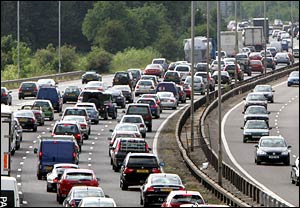
The Department for Transport (DfT) has committed £15bn for investment in the Strategic Road Network of interurban roads over the next five years. To justify this programme, known as the Road Investment Strategy (RIS), DfT has published an economic analysis based on standard appraisal practice in line with DfT’s WebTAG guidance. The main monetised benefit is the saving of journey time that is supposed to arise from investments that increase road capacity.
For 25 major schemes already announced, the average benefit-to-cost ratio (BCR) is estimated to be 4.5, which is considered to represent very high value for money. An estimate is also made of the whole investment programme as a package, using the Department’s National Transport Model (NTM) (see my article on the Road Traffic Forecasts for a critique of this model). Overall the RIS is forecast to deliver benefits to road users worth over £40bn with a BCR of 4.6, much of which comes from a 1.9% reduction in time lost due to congestion across the road network.
It is recognised that this reduction in congestion is likely to result in some increase in traffic – known as induced demand – as people take advantage of the time savings by changing their travel behaviour. But the NTM forecasts this increase in traffic to be only 0.19% by 2040. Moreover, evaluation of completed major road schemes by the Highways Agency (see below) suggests that only 12% of schemes had evidence of induced demand effects.
Evaluation of completed road investments
The Highways Agency has carried out evaluations of the impact of completed major projects (known as Post Opening Project Evaluation (POPE)). These are conducted five years after the opening of the new road. The first overview of a set of such studies (know as a meta-analysis) covered 58 major schemes and concluded that on average a scheme saved users 3 minutes during the peak traffic period and 2.5 minutes at other times. A second set of studies of 75 completed schemes confirmed that journey time savings are the main monetary benefit (75% of the total, with safety improvements the second biggest contribution) but did not highlight the average time saving (although Figure 4-18 indicates that the observed time savings were similar to the first set).
So the main economic benefit of investment in major road schemes is small time savings per vehicle, of the order of 3 minutes on average, multiplied by a large number of vehicles, then multiplied by values of time saved whether for more productive work or more valued leisure. One difficulty with this approach is that any such small time saving arising from a single investment is unlikely to be big enough to change behaviour of road users. The counter-argument is that the economic case should not depend on whether an improvement is carried out as a single large project or as a series of smaller improvements, hence in logic the small time savings in the latter case should not be disregarded.
A weightier criticism of the time savings methodology is that average travel time is invariant. The National Travel Survey (NTS) has been measuring average travel time for 40 years. As shown at NTS Fig, this has remained at about 370 hours per person per year or an hour a day. This finding implies that in the long run there are no time savings that we would value because they allow more productive work or valuable leisure. Any travel time savings must be short run and therefore are not a sound basis for valuing investment in long lived infrastructure.
Land use change disregarded
What has changed over the 40 years of the NTS is the average distance travelled – 4500 miles in 1973, reaching 7000 miles by 1995 (by all modes except international air). This is the result of investment that has permitted faster travel. In the long run, people do not take the benefit of transport investment in the form of time savings but rather as greater distance travelled, which allows more access, opportunities and choices, and which in turn results in changes in land use.
The long run consequences of transport investment are to make land more accessible for productive use. This is exemplified by the regeneration of East London, Docklands and beyond, through rail investment – Docklands Light Railway (DLR), Jubilee Line, Overground, with Crossrail under construction. Public investment in the rail system makes brownfield land more accessible, which allows private developers to construct commercial and residential property, which accommodates new jobs and homes, and which results in enhancement of land and property values that reflect the economic benefit of the public investment.
Railway investment to make land accessible and productive is nothing new. In 1850 the United States’ economy was small, not much bigger than Italy’s. Forty years later, it was the largest economy in the world – the result of the railways, which linked the east of the country to the west, and the interior to both. They gave access to the east’s industrial goods; they made possible economies of scale; they stimulated steel and manufacturing—and the economy boomed.
The standard approach to transport economic appraisal disregards changes in land use, even though enhancement of value is evident in the property market, because inclusion would double count the benefits already estimated as time savings. However, changes in land use and enhancement of values (whether as freehold or leasehold land and property values or as rents) is very relevant to investment decisions, both as regards the spatial location of benefits and their distribution amongst beneficiaries. A public investment that benefited only existing property owners would not represent good value (unless the extra revenue from fares covered the cost – rarely possible in practice). A transport investment that makes land available for development, as in East London, benefits landowners as well as the businesses and individuals who occupied the new properties Such landowners might be expected to contribute to the financing of the investment, as indeed has happened to some extent with developments in Docklands.
Land use change as a consequence of transport investment is not limited to new railways, although it can be more evident than in the case of roads where investment generally improves existing routes and so changes are incremental. But such incremental changes should not be disregarded since they are the long run outcome of road investment.
“You can’t build your way out of congestion”
This is what transport ministers used to say when they did not have a big budget for road building. The statement is substantially true, on account of the phenomenon of induced traffic. Investment in the inter-urban road network is justified by time savings arising from increased capacity which reduces congestion. But such time savings are transient and are converted into land use changes in the long run, which has implication for traffic volumes.
Congestion on the inter-urban road network mainly occurs near to densely populated areas. Remote from these, the traffic mostly flows freely. But adjacent to conurbations, half the traffic can arise from local people using the road for short distance daily travel, as evidenced by the typical pronounced morning and evening peaks from commuting. Widening the road initially results in reduced congestion and faster travel. But over time the locals take advantage of the higher speed to make longer trips, particularly when changing job or moving house. This extra local traffic restores congestion to its former state, and long distance road users are no better off. The longer local trips are associated with changes in land use – development of greenfield sites where permitted, and enhancement of property values that reflect improved access.
This additional traffic resulting from road improvements is known as ‘induced traffic’ or ‘induced demand’. It corresponds to the increased average distance travelled as recorded in the NTS, because people take the benefit of investment as access not time savings, in the long run. It is therefore surprising, as noted earlier, that the NTM forecasts the increase in traffic from planned investment to be only 0.19% by 2040.
In the past, the DfT’s road scheme appraisal methodology assumed fixed origins and destinations of trips, hence no induced traffic or land use change. were allowed for. Subsequently, it was recognised that a change in supply would lead to a change in demand, but nevertheless most of the major schemes of the Highways Agency that have been evaluated were originally appraised on the basis of fixed demand.
Moreover, as noted above, evaluation of completed major road schemes in the Highways Agency’s Post Opening Project Evaluation (POPE) suggests that only 12% of schemes had evidence of induced demand effects, which suggests a deficient evaluation methodology. Five years may be too early to see the full effects of land use change and induced traffic. And because such consequences were not of interest at the appraisal stage, a blind eye may be turned at evaluation.
Recent developments in thinking about investment economics
There have been some interesting developments in thinking about the economic benefits of transport investment, particularly the contribution to economic growth.
Transport for London (TfL) and Transport for Greater Manchester commissioned a report from the economics consultant Volterra Partners that highlights the mismatch between the standard approach to transport appraisal, which focuses on welfare benefits to travellers, and the impact of transport investments on wider economic potential, both spatial and temporal developments. TfL is preparing a business case for Crossrail 2, the planned new SW-NE rail route across London, consistent with the Volterra report.
The Treasury has recently issued supplementary guidance to the Green Book, the source book for public sector investment appraisal methodology, on the topic of valuing infrastructure spend, where it is recognised that new infrastructure may impact on land values. However, it is reiterated that increased such values effectively capitalise the value of time savings that are captured in the standard cost-benefit analysis, so to include them would be double counting. The Treasury therefore persists in the view that notional, unobserved, short run time savings are a better measure of economic benefits than are real, observable changes in market values of land and property made more accessible by the transport investment.
DfT commissioned a thorough study from three notable economists (Tony Venables, James Laird and Henry Overman) on the implications of transport investment for economic performance (the TIEP report). It is recognised that increases in land values are associated with urban transport projects and that commuters who see their travel times cut may end up transferring the benefits to their landlord in higher rent. It is proposed that changes in land use should be estimated and reported for a wider range of projects, and that techniques for predicting such change be further developed. Nevertheless, this report endorses the usual disregard of such changes in land values, as this would be double counting of conventional time savings benefits.
The TIEP study recognises that transport investments can deliver economic benefits over and above conventionally measured user benefits, which arise by: (a) fostering intense economic interaction that raises productivity, whether in clusters within narrowly defined areas or more widely by linking areas; (b) shaping the level and location of private investment, potentially leading to higher levels of economic activity in some areas. What the report does not recognise, however, is that changes in land and property values, as seen in the market, incorporate such agglomeration and related benefits, which need not be separately estimated.
Thinking outside the box
The conventional approach to transport economic appraisal, where the main benefit is time savings and land use change is disregarded, has been well established for half a century and is used in many countries. Arguably, transport economists have taken a blinkered view, not noticing alternative viewpoints, three in particular.
The nineteenth century economist, von Thuenen, developed a direct relationship between transport costs and land values. He postulated a city surrounded by agricultural land that was let to tenant farmers who paid rent to land owners. The rent that could be paid depended on the value of the produce when sold in the market in the city, the production costs, and the transport costs incurred in getting the produce to the city. The higher the transport costs, the lower the rent that could be afforded. Far enough away, land would be good only for subsistence farming. Von Thuenen published his seminal treatise in 1826, before the coming of the railways, which reduced transport costs and made much more land valuable for agriculture, as in the US Mid-West. Von Thuenen’s approach was extended to urban economics by Alonso and others, and continues to be developed.
Behavioural economics focuses on how decision making departs from the rational behaviour assumed in standard economic models. Daniel Kahneman was awarded the Nobel Prize in Economics for using cognitive psychology to explain various divergences of economic decision making from neo-classical theory. The underlying argument is that we need to observe how people actually behave, rather than rely on assumptions of rational utility-maximising behaviour. In the case of transport economics, we observe that, in the long run, people take advantage of improvements to the transport system to travel further, not to save time in order to carry out more work or have more leisure. Transport investment decisions should be based on observed behaviour, not assumed behaviour.
Thomas Piketty’s book, Capital in the Twenty-First Century, has attracted much interest since publication in 2013. It is concerned with wealth concentration and distribution, and with increasing inequality. This is relevant to travel in two respects. First, travel is a relatively egalitarian domain in that it is hard to pay more to go faster. First Class on plane or train offers greater comfort, not speed. Top of the range supercars go no faster on congested roads than a basic family hatchback. So increasing wealth does not buy faster travel, at least not until private jets or helicopters become affordable.
Transport economists argue that road pricing is the answer to congestion – ration a scarce resource by price. However, the usual economic case for road pricing neglects an important externality – the preference of voters for equity rather than efficiency in respect of use of the road network, a preference revealed in referenda in Manchester and Edinburgh for example. Such preference, when quantified and monetised using Stated Preference methods, and incorporated into the cost-benefit analysis, would be expected to tilt the balance against road pricing schemes.
The second aspect of Piketty’s opus that is relevant is his use of long time series of income and wealth, compiled from official records, to help interpret the trends that have led to the present position. This approach contrasts with the standard technique of building a formal model, calibrated using quite recent data. The NTS data shown at NTS Fig is an example of a time series that demonstrates a change the underlying driver of travel demand, without recourse to formal transport modelling.
Investment decisions
The economic basis of transport investment appraisal is not just a matter of theoretical interest. It affects the investment decisions that are made. The conventional methodology, focusing on time savings and neglecting land use change, biases investment decisions against urban rail schemes that can make land accessible for development. The early rail developments in Docklands were marginal on the basis of the cost-benefit analysis at the time, but went ahead because the promoters had strategic vision – amply justified by the outcome. But other cities were less lucky. Alan Wenban-Smith has recounted how, in the early 1990s, Birmingham concluded that supporting a larger and more attractive city centre would need no more money for transport overall than in the past, but spent differently: roughly 50/50 rather than 75/25 road/rail. Although this principle was accepted at the highest levels of the DfT, the strategy was undone by an appraisal system that passed the road and failed the rail elements. (Wenban-Smith LTT Viewpoint – Cities 2Feb12 )
The conventional appraisal methodology biases in favour of road schemes that offer small notional time savings, which, when multiplied by a large number of vehicles, yield apparent large aggregate time savings which are supposed to allow more productive work to be carried out and more valuable leisure to be had. But in reality, these supposed time savings are converted into land use changes located fairly near the improvement, which may or may not be desirable, and which in any event do not form part of the investment case.
If we can’t build our way out of congestion, what can be done? When road users are asked in surveys why congestion is a problem, journey time unreliability is more important than slower speeds. So the best means of dealing with congestion is to provide the user with reliable predictive journey time information prior to the trip, so the optimum time of departure can be judged. However, the valuation of the benefits of reliability is not well developed, and the behavioural responses of road users to information are not well understood – which means that the case for investment in the relevant technologies is difficult to make. Nevertheless, providing predictive journey time information by means of investment in the digital technologies, to achieve more efficient operation of the road network, is likely to be far more cost effective as a means of tackling congestion than investment in expensive civil engineering works.
Assessment
There exists remarkable commitment to an investment appraisal methodology based on valuing notional travel time savings – savings which are valued because they permit more work or leisure, but which are ‘notional’ because they are assumed, not observed. To the extent they may exist, such time savings are transient since average travel time remains unchanged in the long run. Moreover, because of the reliance on time savings as the main benefit, changes in land use and enhancement of land and property values are disregarded, to avoid double counting. Yet such enhancement of values are real, as seen in the market, not notional, and reflect both the increased access arising from the transport investment and the increased economic potential of the property, including the agglomeration and related benefits.
It is not surprising that the economic case for HS2 is unconvincing, based as it is on travel time saving between London and the cities to the north. What we wish to know is the economic benefit to these cities, which will manifest itself in changes in land use in these locations.
Arguably, transport economists have been seduced by theory. Empiricism would be a better approach. Let us observe the behavioural response to the intervention – how travel behaviour changes following a transport investment – which we ascertain through open-minded evaluation of completed schemes. We then use what we have learned to inform appraisal of prospective schemes. An empirical approach avoids double counting since people cannot do two things at the same time.
Since transport investments that result in faster travel lead to increased access and hence changes in land use associated with development, it would be sensible to plan transport investments and the associated development together. This sometimes happens naturally, as would be the case if a new runway were built at Heathrow or Gatwick, when surface transport access would need to be reinforced. This would be a sensible approach generally, since it would secure the real benefits from transport investment.