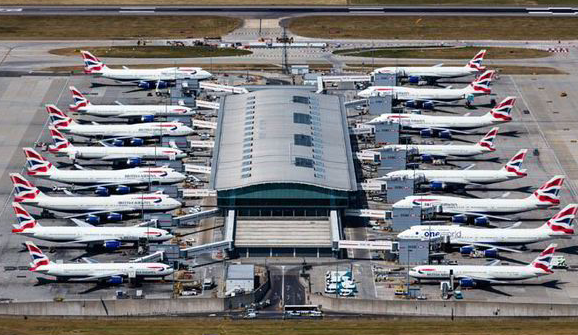
The Government is struggling to reach a view on the recommendation of the Airports Commission that another runway be built at Heathrow. Both the main political parties are divided on this issue. Local MPs are generally against, as are the candidates in the 2016 election for Mayor, on account of environmental impacts.

The Airports Commission forecasts a doubling of passenger numbers by 2050, hence the need for new runway capacity. I have argued previously that there is much more downside uncertainty in this forecast than the Commission believes, in part because the market for air travel may be more mature than generally supposed.

Quite apart from forecasting questions, there are reasons to suppose that we could cope quite well without a further runway in the southeast England, whether at Heathrow or elsewhere. To start with an argument by analogy.

Road capacity constraint

In the 1970s London decided not to enlarge the road network to accommodate growing car ownership. The retained historic street pattern has constrained car use such that car traffic has not increased over the past 20 years, a period of population and income growth. So the share of journeys by car has fallen, while investment in public transport, rail in particular, has met the mobility needs of inhabitants and visitors. London has thrived economically, culturally and socially despite a major transport capacity constraint – the road system. We have worked around this by investment in rail that provides speedier and more reliable travel than the car on congested urban roads.

Airport capacity constraint

If we did not construct another runway, how would we cope? What would be the workaround? For air travel this lies within the system. Three–quarters of passengers are on leisure trips. Even at Heathrow, 70% of passengers are tourists or visiting family and friends. Yet the arguments for more runway capacity are very largely about the need to allow for the growth of business travel – to help British businesses develop new markets and to foster inward investment into the UK.

The case for more airport capacity to support tourism is weak. While London’s hospitality, entertainment and retail sectors would welcome more inbound visitors, Britain has a negative balance of trade in tourism, the British abroad spending a lot more each year than overseas visitors to the UK. Moreover, London, the inevitable destination of first time visitors, is essentially a working city where excessive numbers of tourists arguably detract from the quality of life. Promotion of inbound tourism might better focus on places outside the capital, accessible from regional airports.

Market response

If we decided not to construct a further runway at Heathrow, the market would respond to this capacity constraint. Business travellers would command priority since they would be willing to pay for the convenience, connections and direct flights at Heathrow. Growth of business travel would displace leisure travel, both within aircraft on existing routes and between routes, where there are trade-offs of time against money. For instance, if I need to travel to India on a business trip for which others are paying, then if possible I would fly direct from Heathrow. But if I am on a holiday visit, paying out of my own pocket, than I may choose the cheaper alternative via a Middle East hub, the inconvenience of the change of aircraft being acceptable for the more attractive price.

At present, both routes to India start from Heathrow. If business travel grew, the airlines would serve the routes with larger aircraft. If demand grew yet further, then alternative departure points for leisure travellers would be offered, such as Stansted, which has plenty of spare capacity.

Growth of business travel in conditions of capacity constraint would be profitable for both the airlines and Heathrow airport. If profits were judged excessive, there are regulatory interventions that could be considered to prevent users from being exploited.

Assessment

There is a case for an additional runway in southeast England, as argued by the Airports Commission. But if it proves too difficult to agree where to build it (and how to finance it, given the uncertainty of forecast usage), then we could manage without. The market would give priority to business travellers. Leisure travellers are more flexible and would take advantage of alternative routes that the airlines would offer.

A version of this article appeared in The Conversation on 11 December 2005


High Speed 2 (HS2), the planned new rail route from London to the cities of the Midlands and the North, is a controversial project, about which I have been rather agnostic. What are the pros and cons?

Demand for rail travel has been growing rapidly, with passenger numbers doubling over the past 20 years since the industry was privatised. Has this growth arisen because of or despite privatisation? Probably both: the train operating companies have invested in new rolling stock, which attracts customers; but growth has also been the result of road congestion, digital technologies allowing productive work on rail journeys, the shift of the economy from manufacturing to business services located in city centres, and more people living in cities without a car.

We can expect demand for rail travel in Britain to continue to grow, driven both by population increase and by the attractions of an improving network that offers fast and reliable travel. Hence the need to invest in track, stations, signalling and rolling stock. Additional capacity on existing routes is publicly acceptable despite weekend interruptions to services, and can be cost-effective if spare capacity exists, although the decade-long modernisation of the West Coast Main Line in recent years was problematic, involving delays and cost over-runs. Longer trains and longer platforms, with a smaller proportion of first class seats, is one approach. Most rail investment involves improving existing routes, or occasionally reviving disused track, for mixed passenger and freight use. The main exception is HS2, a new build high speed route for fast passenger trains only.

The development of HS2 is being carried forward by a Government-owned company. A Bill is currently being considered in Parliament to secure powers to construct and maintain the first phase, London to Birmingham. The strategic case for HS2, published in 2013, argues that this offers a step change in north-south connectivity, at a cost for a high speed line of 9% more than a conventional railway. Travel time from London to Birmingham, for example, would be reduced from 1hr 21min to 49min. Long distance trips transferred to the new line will free up capacity on existing services for additional commuter services.

Economic case

An important part of the case for HS2 is the economic case. On the standard approach to transport cost-benefit analysis, where the main economic benefit is time saving through faster travel (valued because this permits more productive work or desired leisure), the benefit:cost ratio for the first phase is estimated to be 1.7 and for the whole route 2.3. These values take some account of a debate about the value of time savings when one can work on the train.

The Economic Affairs Committee of the House of Lords has issued an illuminating report critical of the case for HS2, making the following key points:
• Business travellers, who derive 70% of the transport benefits, should pay higher fares than for standard rail journeys.
• Long term growth of demand for rail travel is unclear; overcrowding arises from commuters, not long distance users who would most benefit from high speeds.
• The economic impact is unclear; the economic case based on the value of time saving is unconvincing; and London may be the biggest beneficiary.
• There are better ways of spending £50bn, the cost of constructing HS2, track and trains.

The Government responded to the House of Lords report, rebutting the criticisms without shedding further light on the economic case.

Assessment

The economic case for HS2 relies largely on estimates of the benefits to business travellers from speedier journeys, for instance saving half an hour between London and Birmingham. The value of this benefit depends on the future number of travellers and on estimates of the value of time savings – both subject to considerable uncertainty. The Department for Transport has recently published research findings that would increase the value of time savings from long distance rail travel.

What the conventional economic case does not illuminate are the benefits to the cities of the Midlands and the North of the new rail route arising from new urban developments. To include the enhanced value of land and property that would arise from improved access and connectivity would be double counting the time savings benefits, according to the orthodox view. This view has nothing to say about distribution of benefits other than to different classes of travellers (business, commuters, leisure) – nothing about spatial distribution as between cities and regions, nor about benefits to existing land and property owners.

An approach to economic analysis of transport investments that was based on spatial economics would allow changes in land use and enhancement of land and property values to be taken into account as reflections of the economic benefits of improved access. This is what happens, in effect, when a particular transport investment is promoted as part of a more general development – an example is the planned extension of the Northern Line tube in London to allow the development of the Nine Elms riverside site.

Appraising the development potential in the cities to the north of London that would result from HS2 is difficult, given the many uncertainties. Much depends on the efforts made by the city authorities to take advantage of the new rail route, efforts that are seemingly being undertaken with some enthusiasm, as well as on the commercial judgement of the developers. But it is clear that the range of uncertainty associated with such a large, single, hopefully transformational investment is substantial. So unless the benefit-to-cost ratio is large (unlikely for HS2 however valued), the political judgement to proceed could not be based on a clear economic case.

We cannot be sure that the main beneficiaries of HS2 will not be businesses based in London. The challenge for the cities to the north is to prevent this outcome.

I gave a talk on this topic at a recent meeting of the Transport Economists Group, one theme of which was the subject of the previous article. My overall conclusions are set out below.

A number of new trends emerged in the 1990s, or in some cases are still emerging:

  • There has been no growth in average distance travelled in Britain for more than 20 years, whether by all surface modes or by car alone. Available data suggests that this holds for the developed economies generally. This contrasts with the previous century and more during which average distance travelled increased steadily.
  • One reason for this cessation of growth of distance travelled lies in technological constraints on faster travel. We cannot drive faster on the roads, safely and with acceptable emissions. We have high speed rail to come, but rail is responsible for a minority of trips, and high speed rail for a minority of a minority. These technological constraints mark the end of an era that began in 1830 with the first passenger railway, which harnessed the energy of fossil fuel to permit travel at faster than walking pace.
  • Car-based mobility or access to good public transport allow high levels of choice of many regularly used types of destination, thus lessening the need to travel further.
  • Travel demand per capita has ceased to be driven by growing incomes. Total travel demand is now determined largely by population growth. However, the pattern of such demand will depend on where the additional inhabitants are housed – if on greenfield sites, more car use; if within existing urban areas at higher density, then more public transport.
  • Car use in big cities has passed its peak, in term of mode share, and is now declining. Successful cities attract people to work, study and live, so population density increases. The city authorities recognise that the road network cannot be enlarged to accommodate increasing car use, so investment in urban rail is needed to meet the mobility needs of the population.

So travel in the twenty-first century will be different from travel in the twentieth century, quite apart from the impact of technological developments such as driverless cars.

In contrast to these new trends, one unchanging feature is average travel time of about an hour a day, found for all settled human populations. This constitutes a sound basis for forecasts or scenarios of future travel. Travel/transport models should be constrained to hold average travel time constant in the long run. They also need to recognise the new trends outlined above as regards both model structure and calibration. Most existing models are obsolete.


I gave a talk to the Transport Economists Group in London on 28 October 2015. Much of the material covered can be found in recent articles on this website. One new theme is set out here.

The Government has announced its Road Investment Strategy that commits £15 billion expenditure over the next five years. One stated aim is a ‘free-flow core network, with mile a minute speeds increasingly typical’. How realistic is this?

Let’s consider the past pattern of travel behaviour that has been tracked over the past forty years by the National Travel Survey. Average travel time has stayed steady at about 370 hours a year, or an hour a day, a finding that holds true for all settled human populations. What has changed over the period is the average distance travelled, which increased from 4500 miles a year in the early 1970s to 7000 miles in the mid 1990s, since when this has ceased to grow. Increased distance in unchanged travel time is the result of investment in the transport system that has permitted faster travel – private investment in cars, public investment in roads and railways.

Not time savings

People have taken the benefit of investment by travelling further to more distant destinations, not by saving time in reaching unchanged destinations. This is contrary to what transport economists suppose when they estimate the main benefit of investment as time savings, valued for the extra work or leisure supposedly made possible. In reality, people travel further to have more opportunities and choices. For instance, by travelling faster on the journey to work, you have more choice of jobs accessible from where you live in the time you allow yourself for travel, more choice of homes accessible from your workplace, and similarly more choice of shops, schools and so forth.

So people take advantage of road improvements that permit faster travel to make longer trips as part of their daily routine. This is particularly the case in areas where demand for housing exceeds supply, creating an incentive to travel further in search of affordable properties.

Interference

Daily travel is an important component of traffic on parts of the Strategic Road Network (SRN). Congestion on this network arises near to populated areas, where local users interfere with long distance users. Half the traffic on the M25 is local. Remote from populated areas, the traffic generally flows freely. The conventional response to congestion on the SRN is to add capacity – an extra lane, conversion of the hard shoulder, or an improved junction. Conventional economic appraisal involves multiplying small time savings from such capacity increases by a large number of vehicles and by standard values of time to generate monetary benefits that can be compared with the costs of the extra capacity, to assess value for money.

Small savings

The time savings per vehicle are quite small. The Highways Agency (now Highways England) carried out evaluations of around 120 completed major improvements and found the average time saving to be three minutes at times of peak congestion. There has been debate about the value of such small time savings. One view is to disregard these as too small to change behaviour. Against that, it is argued that small time savings can accumulate as more improvements are implemented, so in logic all need to be counted.

While three minutes is too small to matter for a long distance trip, it is not insignificant for a local journey. So if we add carriageway to a congested section of the SRN, it is the local users who take advantage of the faster travel to make rather longer trips, particularly for greater choice when they change jobs or move house. These lengthier trips generate extra traffic,  which restores congestion to what it was previously. Long distance users are no better off.

Induced traffic

This extra traffic is what is known as ‘induced traffic’, about which there used to be debate – did it arise and if so why? We can now see that induced traffic is the extra traffic that arises because people take the benefit of road improvements that allow faster travel as more opportunities and choices at greater distances, consistent with the evidence of the National Travel Survey, rather than as time saved.

Occurrence of induced traffic is the basis for the maxim: ‘You can’t build your way out of congestion’, which from experience we know generally to be true. This is what transport ministers at one time used to say, when they did not have a big budget for road construction. Current ministers tend to speak rather vaguely about new road schemes ‘creating opportunities for hardworking people across the nation and driving economic growth’, but no doubt hoping that congestion would be lessened, as is seemingly implied by the time saving rationale.

What road construction can achieve is to make land accessible for development. But this needs to be led by planners and developers identifying sites suited for development that are commercially attractive. If such sites require improved road access, then this should be a candidate for funding, whether from a local transport investment budget or a national funding programme, subject to a value for money test. Such local initiatives fit with devolved funding, not as part of a national Road Investment Strategy for which local development is inadvertent or incidental.

Unreliability

If we can’t build our way out, what do we do about congestion? Surveys of road users find that the main perceived problem arising from congestion is unreliability, rather than increased time taken. We can tackle the unreliability problem by providing road users with good predictive travel time information before they set out, so reducing uncertainty in arrival time. This is becoming increasingly possible through digital technologies, which are far more cost effective than traditional civil engineering technologies in meeting the needs of road users. In Britain, we are familiar with roadside variable message signs predicting the time to the next junction – although this tends to be too late to be of much use.

One example of useful predictive travel time information is found at Seattle, where you can input the postcodes of your home and workplace, and the time you want to arrive at work, to be advised of the time to leave home to arrive on time nineteen times out of twenty. A more ambitious example has been in operation in Nordrhein-Westfalen in Germany, where a simulation model of the autobahn network predicted journey times for any kind of trip (although this website seems no longer to be active). Such simulation models may be expected to improve their predictive accuracy as computers become more powerful, faster and cheaper and can process increasing amounts of input data.

Two kinds of driver

Predictive journey time information can be used by the two kinds of driver on the roads. Those who need to be at their destination at a particular time will know when they need to set out – whether to get to work or a meeting, or deliver time-critical goods. Those who are more flexible may be able to use such information to avoid peak traffic – for instance when on shopping or leisure trips or visiting friends. The more the flexible drivers can avoid peak traffic, the less congestion for those who have to be on the roads at that time – which is win-win.

Anecdotal evidence of the usefulness of digital technologies is to be found in Just-in-Time delivery, offered by efficient road freight haulage businesses who understand the road network well and can manage their vehicle fleets to perform rather precisely. For instance, a haulier working for a supermarket business to deliver from the central warehouse to the stores may be contracted to deliver within 30 minutes time slots, and can do so.

Digital futures

These digital technologies need to be made generally available. Highways England has an important role. The investment case for digital technologies requires monetary values for journey time reliability, which might be available from the latest Department for Transport research on the value of time. The investment case also requires information about drivers’ response to predictive information about journey times, which is researchable, albeit not a static situation since positive responses are likely to increase with familiarity.

A further consideration is the information currently made available by specialist providers such as TomTom or general providers such as Google. It is not clear how reliable is this information or what impact it is having on the functioning of the road network. Nevertheless, there is scope for collaboration between Highways England, which has an interest in the overall efficiency of the SRN, and the private sector businesses that provide information to individuals for reward, directly or indirectly.

Assessment

It is a step forward that Highways England’s recent Concept of Operations recognises the importance of maximising the throughput of people and goods through initiatives such as smart motorways and Intelligent Transport Systems ‘to squeeze every drop of capacity out of what we have’.

So while we can’t build our way out of congestion,  we can manage the problems arising from congestion far more effectively. But to do that, we need a substantial reallocation of planned expenditure within the Roads Investment Strategy. The £15 billion spend over the next five years includes some ring-fenced funds for Innovation (£150m) and Growth & Housing (£100m). However, these earmarks are a tiny proportion of the total, with the bulk of spend devoted to traditional civil engineering work aimed at increasing capacity – a very twentieth-century approach that is not appropriate for the digital twenty-first century.


There is growing interest in the idea of sharing, The ‘sharing economy’ takes advantage of the internet to bring into use excess capacity, whether under-used assets (private cars, spare bedrooms) or labour (people willing to put in a few hours of effort). This is a disruptive economic force that unlocks new sources of supply at lower cost, which will benefit consumers but could be detrimental to traditional suppliers.

For transport, the sharing economy can take various forms. Private parking space can be hired to others. Ride sharing involves people sharing the car and the cost, whether colleagues on regular journeys to work, or new friends on one-off longer trips, for instance using liftshare or Bla Bla Car. Uber has introduced UberPool, a shared taxi service, with lower fares – its success will depend on the ability to match enough passengers going in the same direction. Ride sharing improves the occupancy of cars, a real efficiency gain, and reduces carbon and other emissions per capita.

However, the main opportunities seems to be in shared ownership, taking advantage of the fact that most private cars are parked for more than 95% of the time. Car rental by the day is familiar. Car clubs allow people to avoid owning their own car when their need to drive is limited. One model requires vehicles to be returned to the point of origin, normally close to where you live. Another approach allows return anywhere within a defined area. This kind of short-term car sharing is in competition with taxis, where costs have been reducing under the influence of Uber, which has also made booking and paying convenient.

There is much current interest in the possibility of driverless cars – essentially taxis with robot drivers. These may be particularly suited to ownership models other than the standard private car, since it is supposed that such autonomous vehicles could travel when empty to where needed by the next user.

A number of major car manufacturers have announced Airbnb-style schemes that allow car owners to earn money by renting out their new vehicles to others. This is a response to the disruption of traditional consumer sectors by both the concept of sharing and the declining use of cars on the part of the urban young – both because of the costs of ownership and the alternative modes of transport increasingly available in successful cities.

Assessment

It makes sense to share under-used assets where that is convenient for those concerned. But how much difference will car sharing in all its forms make to road use, if its growth continues?

  • Car ownership would be reduced but car use would be more intensive, which might make little difference to overall traffic. The implications for the vehicle manufacturers are unclear.
  • Roadside parking could be reduced if personal ownership declines. But this would be in the neighbourhoods where on-street parking is permitted, so the impact on urban traffic congestion would not be great. There would be fewer people driving around to seek a parking space, but more empty driverless cars seeking the next user.
  • Car use could be reduced since those who don’t own their own cars make less use of cars.
  • Ride sharing could reduce car use, or it might take people away from public transport.
  • Driverless taxis might allow cheaper fares, which would increase demand. The impact on congestion would depend on how much reduction in private ownership took place.

Altogether, the impact of car sharing on road use seems unlikely to be substantial, at least in the near term. However, it is possible to envisage for the longer term what might be termed a ‘shared/shared driverless’ scenario – shared ownership of driverless vehicles with shared use. This could reduce urban traffic congestion through high occupancy requiring fewer vehicles. A recent paper suggests one such vehicle could replace nine conventional cars in a US city.

Moreover, if priority were given to shared/shared driverless vehicles through road pricing or similar demand management measures, it might be possible to avoid urban traffic congestion while offering speedy and reliable door-to-door travel. This would be facilitated by some central oversight of such vehicles to minimise conflicts and maximise efficient use of the road network (analogous to air traffic control). The outcome would allow the car to compete with rail in urban areas, and could help cities without rail infrastructure to meet the mobility needs of the citizens efficiently.


2015 marks the 50th anniversary of the first data collection of the British National Travel Survey (NTS). The Transport Statistics Users Group and the Department for Transport held a meeting on 23 September at which I was one of the speakers. My presentation is available Metz tsug 23-9-15. This article outlines what I said about air travel. A previous article dealt with daily travel.

Cessation of growth of air travel

Slide 11 of my presentation shows how passenger numbers using UK airport grew rapidly prior to the recession, with grow now seemingly resuming. The Government set up the Airports Commission to look at the case for additional runway capacity. The Commission’s growth projection is shown in Slide 12, based on an econometric model of demand for air travel, a refinement of a model developed by the Department for Transport. The Commission sees passenger number doubling by 2050 and has therefore recommended that an additional runway be constructed at Heathrow.

It is, however, illuminating to disaggregate historic demand by market segment. Slide 13 shows passenger numbers flying between the UK and USA. Growth was strong until 2000, when it stopped. This cessation coincided with 9/11, so no surprise at the immediate dip. What is unexpected is that growth did not resume, so either the effects of the terrorist attack have been long lasting, or other factors have come into play.

Slide 14 shows passengers flying to and from the UK and Japan, displaying a clear peak followed by a halving before bottoming out – seemingly an example of ‘peak air travel’. But could this be a statistical artefact? The data is published by the Civil Aviation Authority (CAA) based on reports of passenger numbers from the airlines. It might be that some passengers whose end destination is Japan are reported as flying to the Middle East if they change aircraft at one of the rapidly expanding hub airports located in this region. However, we have an independent check in the International Passenger Survey which asks returning UK residents where they have spend their time abroad, and departing overseas residents about their country of origin. Slide 15 shows visits to and from Japan – the halving of numbers is confirmed.

The US and Japan are exceptions to the general trend for air travel to and from the UK to increase over time. But these are important, well-established market segments; what we are seeing here may be evidence of market maturity that may in future become apparent in other segments. It seems likely that current econometric models of demand for air travel do not take account of the behavioural factors contributing to the plateauing and peaking seen for the US and Japan and thus are significantly mis-specified.

Time constraints

One factor that may limit air travel is time constraints. For daily travel (ie surface travel) there are only 24 hours in the day and many essential activities to fit in, so that travel time is constrained to one hour a day on average. For flying, it is not the hours in the day, but the days in the year that constrains travel – not the time spent in the air but the time away from responsibilities at home and work. We have no relevant data, but it is likely that for most people such constraints exist in principle and for some they may already bite. Time constraints on being abroad could cause travel to established destinations to cease to grow, or even to fall, as new destinations open up, whether for business or leisure.

Time abroad does not relate simply to frequency of air travel. If you spend two weeks away in one place, that involves one return flight. If you spend two separate weeks away in different places, that involves two such flights. We have information on frequency of flying from the National Travel Survey (NTS), not from the seven-day travel diaries (which wouldn’t pick up most air travel), but from a specific question  (NTS0316) about how many times respondents flew in the previous 12 months. This question has been asked for nine years, with the outcome shown in Slide 16. The pattern is stable, with over half the respondents reporting no flights abroad in the past year. I call these the ‘Infrequent Flyers’ – some fly rarely, some never, and some may have flown regularly in the past.

Infrequent Flyers

These Infrequent Flyers are of interest as a potential source of future demand for air travel, if their needs could be better met. We know something about them from the NTS, which collects information about the personal characteristics of respondents – age, gender, income, socio-economic status, place of residence. Slide 17 shows how the proportion of infrequent flyers declines with increasing income, as expected since affordability would be important for those on low incomes. However, 30 per cent of those in the top quintile don’t fly, even though they could very probably afford at least one trip, so that other factors are important.

Most of what we know about the characteristics of people who fly comes from surveys of passengers at airports carries out by the CAA. But of course the Infrequent Flyers are not usually seen at airports. However, earlier this year the CAA commissioned a household survey of attitudes to air travel which, like the NTS, includes this group. One example of the findings is shown in Slide 18, where it can be seem that the biggest single barrier to flying by the Infrequent Flyers is budget constraints.

So the Infrequent Flyers might fly more often in the future if their incomes rise faster that the costs of travelling abroad – hard to judge how likely that is. One important affordability factor that has boosted air travel in the past has been the growth of the low cost carriers (budget airlines), but market penetration seems largely complete as regards short haul leisure markets, with the prospects for long haul very uncertain. So the affordability boost may now be largely historic.

Assessment

Slide 19 summaries my conclusions on the prospects for the growth of air travel. There is emerging evidence consistent with market maturity as an important consideration. A likely factor limiting growth is time constraints, a topic worth researching. The prospects for the Infrequent Flyers travelling more often are unclear, in part because further price reductions seem unlikely. Altogether, the growth of demand in the future seems a good deal more uncertain than is generally supposed.


2015 marks the 50th anniversary of the first data collection of the British National Travel Survey (NTS). The Transport Statistics Users Group and the Department for Transport held a meeting on 23 September at which I was one of the speakers. My presentation is available Metz tsug 23-9-15 . This article outlines what I said about daily travel. A future article will deal with air travel.

Slide 2 of my presentation shows the main NTS time series, continuous over 40 years (the first data collection 50 years ago was a one off). This covers all modes except international air travel and is derived from 7-day travel diaries, hence covers daily travel. Journey frequency has remained broadly at about 1000 trips a year on average over the period, and average travel time has held steady at around 370 hours a year, or an hour a day. What has changed is the average distance travelled, which rose from 4500 miles in the early 1970s to reach 7000 miles in the mid 1990s, with no further growth in the past 20 years.

The growth in distance travelled, in the unchanged amount of travel time, is the result of investment in the transport system – private investment in more and better cars, and public investment in infrastructure. People have chosen to take advantage of faster travel to reach more distant destinations, not to save time going to previous destinations, to take advantage of increased opportunities and choices. For instance, by travelling faster on the journey to work, you have more choice of jobs accessible from where you live in the time you allow yourself for the commute, and more choice of homes accessible from your workplace; and similarly fast travel allows more choice of shops, schools and so forth.

Benefits of transport investment

Transport economists suppose that the main economic benefit of transport investments takes the form of journey time savings, which are valued because this permits more productive work to be carried out or more valued leisure to be enjoyed. However, the constant average travel time found in the NTS is evidence that there are no such time savings in the long run. So time savings must be short run, succeeded by changed travel behaviour as people choose more distant destinations. This means that we are appraising the value of long lived infrastructure investment based on short run time savings, which is not sensible.

We should ask what is the long run benefit from transport investment. This can be seen in East London, Docklands and beyond, which is being regenerated through rail investment – Docklands Light Railway (Slide 3), Jubilee Line Extension, Overground, with Crossrail under construction. Public investment in the rail system makes land accessible for development by private sector developers who construct residential and commercial property, which accommodates London’s growing population, both homes and employment. This is both the strategic narrative and the causal mechanism whereby transport investment facilitates economic growth. It is not sensible to value these rail investments on the basis of notional short run time savings. The real value is seen, for instance, in the high rents paid for office accommodation at Canary Wharf, reflecting both the access made possible by rail investment and the high value of the economic activity carried out there.

Strategic Road Network

Constant average travel time also provides an illuminating perspective on investment in the Strategic Road Network, shown in Slide 4 where the colour coding indicates the degree of congestion, from black through red and amber to green. In general, congestion occurs near to population centres, where local traffic impedes long distance users. On the M25 around London, for example, about half the traffic is long distance and half is local, importantly people going to and from work, which generates morning and evening peak congestion. Such congestion is seen by the Department for Transport and its roads agency, now known as Highways England, as a reason to increase capacity by adding carriageway. Evaluations of completed major schemes of improvement on the Strategic Road Network show average time savings at peak hours to be about 3 minutes per vehicle. Multiplying a few minutes by a large number of vehicles and by the standard monetary values of time yield economic benefits sufficient to justify the large investment in expensive civil engineering works. This is an example of justifying investment in long lived infrastructure on the basis of short run time savings.

But what happens in the long run? Faster travel resulting from widening the road is to the advantage of local users who can exercise more choice of jobs and homes, when they come to change these, by travelling further in the same amount of time. This generates extra traffic – known as ‘induced traffic’ – which restores congestion to its former level, so that long distance road users are no better off. This is the basis for the maxim ‘You can’t build your way out of congestion’, something that UK Transport ministers used to say when they didn’t have a big budget for roads investment.

What investment in the road network achieves is improved access that facilitates local development. This may be inadvertent as a consequence of misconceived efforts to tackle congestion. Or it may be intentional in support of local plans agreed between developers and planning authorities. However, it is difficult to devise a national road investment strategy on the basis of such local needs.

If we can’t build our way out of congestion, how can we tackle this challenge? Surveys of road users indicate that the main problem with congestion is the uncertainty of journey time. To deal with this we need to provide road users with good predictive journey time information before they set out, so they can plan their trips to arrive on time. This is increasingly possible as the digital technologies get faster, cheaper and more powerful. Digital technologies are very likely to be far more cost-effective than civil engineering in improving the performance of the road network.

Peak or Plateau

Returning to Slide 2, we see no growth over the past 20 years. About three-quarters of the 7000 or so miles travelled each year on average is by car, so it is no surprise that car use per capita has also changed little over this period (Slide 5). This is found not just for Britain but for the developed countries generally, and is known as ‘Peak Car’, although ‘Plateau Car’ might be a better term since, while it is clear that cessation of growth of car use started well before the recession, it is not certain that long term decline has set in.

Since per capita travel by all modes has stabilised, future total travel demand will be driven mainly by population growth, which in Britain is significant. But the pattern of demand growth will depend on where the additional inhabitants will live. If they are to be housed on greenfield sites, they would use cars and the road system would need to be enlarged. If, however, they are housed in existing urban areas where the scope for additional road capacity is limited, then public transport investment would be important.

Peak Car in London

London is an example of a city with a rapidly growing population with no greenfield sites suitable for house building, so that the brownfield sites and infill are being developed, and people are living at higher densities in existing properties. Slide 6 shows how London’s population grew until 1940, followed by a 50 year period of decline as people left a damaged, overcrowded city to seek a better quality of life in new towns, garden cities and the like. But around 1990 the tide turned as people saw again the attraction of city living, with numbers now projected to reach 11.3m by 2050.

While London’s population has been growing for the past 25 years, car traffic and car use has not (Slide 7). This is because of road capacity constraints. Having begun to build elevated motorways in the 1960s to accommodate growth of cars, this approach was abandoned in the face of popular resistance to the damage created in the urban environment. The historic street network has been retained, but with reduced capacity for vehicles on account of bus and cycle lanes, more pedestrian space, as well as parking controls in the inner boroughs and the congestion charging zone in the centre.

If the population of London is growing but car use is not, it follows that the share of journeys by car must be falling, as seen in Slide 8. Car use (driver and passenger) has fallen from 50 per cent of all trips in 1993 to 37 per cent currently. Walking plus cycling has changed little (cycling is growing, but from a low base), while bus and rail have increased, the result of substantial investment.

In Slide 9 the car share of trips in London is extrapolated to cover the century 1950-2050. Data prior to 1993 are based on the assumption that car use in London grew at the same rate as car ownership nationally, which we know from vehicle registrations. Future data is based on the assumption that London’s road capacity will not be increased but that rail investment will continue, in line with the policies of the Mayor and Transport for London. On this basis, the share of journeys by car will decline to about 27 per cent by 2050, despite which (or perhaps because of which) London is very likely to continue to thrive economically, culturally and socially.

The peak seen in Slide 9 I designate as ‘Peak Car in the Big City”. This shift away from car use in successful cities, as exemplified by London, together with the cessation of car use per capita nationally, are helpful in mitigating transport greenhouse gas emissions, as I previously described. The peak marks a transition: from an era in which the growth of travel demand was driven by increasing income to an era in which it is driven by population growth; and from the twentieth century in which increasing prosperity was associated with increasing car ownership to the twenty-first century in which increasing prosperity is associated with decreasing car use in successful cities (and static car use per capita beyond).

It is hardly possible to forecast a peak of the kind seen in Slide 9. A transport planner in London in the 1980s, thinking about the future, would see a 40 year trend in population decline, a 40 year trend in growth of car use, and would extrapolate both in to the future, as would a transport model. What the planner and the model would fail to foresee is the change in the economic structure of London and changed attitudes to urban living and car use. Models assume continuity between past and future, relying on historic relationships (elasticities and the like) to predict the impact of change in exogenous factors such as income and population growth, oil prices, and technological developments. However, the peak phenomenon implies a break in continuity and the need for forward-looking relationships. This is difficult for modellers to cope with since the bulk of the data they have for model calibration is historic.

The peak of car use in London occurred in 1990, 25 years ago, yet the modellers at the Department for Transport responsible for the National Transport Model still do not recognise this – they are in denial about Peak Car. In consequence this Model projects big increases in car traffic in London – depending on the scenario of up to 37 per cent by 2040 in the most recent Road Traffic Forecasts. This is hard to reconcile with the historic trend (Slide 7) and the plans of the Mayor, which do not involve increasing road capacity. The Model is not consistent with observed behaviour in London, nor with the evidence we have for other big cities.

Assessment

To think about the future, we would best focus on the invariant average travel time (Slides 2 and 10). The hour a day has hardly changed in 40 years, and probably for a lot longer, and is found in all other countries. The scope for increase is limited by the 24 hours of the day and all the other activities we need to undertake; and for decrease by the activities we need to reach beyond the home, as well as by the need to get out and about regardless of destination. So it would be sensible to constrain all transport models to hold average travel time constant in the long run. This would change model outputs when used to analyse the impact of a proposed investment, comparing the ‘do something’ with the ‘do minimum’ cases. Rather than time savings, the output would be changed access, land use and land value, which would be appropriate when the purpose of the investment is to stimulate economic growth – comprising population growth and productivity growth, both of which involve land use change.

My conclusions as regards daily travel are summarised in Slide 20. The NTS provides clear evidence that there are no travel time savings in the long run, and that there has been no increase in per capita travel for 20 years, the basis of the Peak Car phenomenon. The current theoretical frameworks for investment appraisal and forecasting are inconsistent with this evidence and hence need to be rethought. Using an economic framework inconsistent with the evidence results in sub-optimal investment decisions.

I see three problem areas. In my view we are investing too little in urban rail because we do not recognise the economic benefits associated with changed land use. Urban rail allows successful cities to grow to higher densities, which results in agglomeration benefits – economic, cultural and social – and which also mitigate greenhouse gas emissions. We are investing too much in civil engineering works on inter-urban roads in the futile hope of reducing congestion, although there is scope for supporting development where planners and developers wish to develop sites that require improved road access. And we are investing too little in the digital technologies that are likely to be far more cost-effective than the expensive civil engineering technologies in dealing with congestion. What we need here is to put monetary values on journey time reliability and to understand the response of road users to predictive information about journey time, as a basis for investment appraisal of digital approaches.

 

The UK Government Office for Science is running a Foresight project on the Future of Cities. I was asked to contribute an essay, the key points of which are:

  • Successful cities are characterised by growing populations as people are attracted to work, study and live. As population density increases, agglomeration effects contribute to economic productivity and to similar cultural and social benefits.
  • Increasing population density precludes enlarging the road network to accommodate growth of car-based mobility. Instead, rail systems must be expanded to provide fast and reliable travel for those who work in the city. So the share of journey by car declines.
  • In London, car use peaked at 50 per cent of all trips in around 1990. It has now fallen to 37 per cent and should fall further to 27 per cent by mid-century, on the basis of current projections and policies. This will make a significant contribution to mitigating transport greenhouse gas emissions.

Transport accounts for over 60 per cent of global oil consumption and about a quarter of energy-related carbon emissions. Typical forecasts of future world vehicle ownership project substantial increases, particularly in the developing economies. The transport sector relies largely on oil for motive power and has been seen as more problematic than other parts of the economy when it comes to reducing greenhouse gas emissions.

The problem of transport greenhouse gases may be less than generally supposed, however. There is emerging evidence that individual car use, as measured by the average annual distance travelled, has ceased to grow in most of the developed economies, starting well before the recent recession, and it may be declining in some countries – a phenomenon known as ‘Peak Car’. A number of explanations have been proposed, which are not mutually exclusive and include a decline in younger people holding drivers licences, changes to company car taxation, saturation of demand for daily travel, technological constraints on faster travel, and a shift away from car use in urban areas.

London

The shift away from car use in cities is particularly important in a world in which future population growth will be mainly urban and the economic attractions of population density are increasingly recognised – agglomeration economics. London illustrates these developments. Over the past twenty years the population has been growing and incomes rising, but car use has held steady at about 10m trips a day. This is mainly because the city has not increased road capacity but instead has invested in public transport, particularly rail which offers speedy and reliable travel for work journeys, compared with the car on congested roads.

A growing population but no growth of car use has resulted in a marked decline in the share of journeys by car in London, from 50 per cent of all trips in 1990 to 37 per cent currently. With continued population growth projected and more investment in rail planned, the share of trips by car could fall to 27 per cent by mid-century. There is every reason to suppose that London will continue to thrive as car use declines – perhaps because car use declines.

This decline in car use from 1990 was preceded by a 40 year period of growth from 1950, the result of growing incomes, growing car ownership and at the same time a falling population as people left an overcrowded damaged city for new towns, garden cities and greener surroundings. So we see a marked peak on car use around 1990, the time when the population of London was at a minimum, when attitudes to city living began to changes.

Peak Car in the Big City

This phenomenon of ‘Peak Car in the Big City’ is not unique to London although this is the city for which we have the best data. There is evidence for something similar happening in Birmingham, Manchester and other British cities as well as those in other developed countries. The shift in economies from manufacturing to services is an important driver, as is the growth of higher education located in city centres, attracting young people for whom the car is not part of the life style.

The Peak Car phenomenon is helpful for mitigating transport greenhouse gas emissions – both the cessation of per capita car use nationally and the decline in the share of trips by car in cities. I have estimated that these changes in behavior, taken together with expected developments on low- and zero-emission technologies, could reduce UK surface transport greenhouse gas emissions in 2050 by 60 per cent compared with a 1990 baseline. This fall short of the overall target of 80 per cent reduction, but is a good deal better than conventional projections.

Peak Car is not just an emerging phenomenon to be investigated. It is a helpful trend to be encouraged to achieve both successful, sustainable cities and national reduction of transport greenhouse gas emissions.


This article is based on a recent paper of mine published in the journal Case Studies on Transport Policy, also available as a final draft Metz CaseStudies 1-5-15 pdf.

Plans are being developed for additional road crossings of the River Thames in East London. Downstream of Central London there are at present two road tunnels (Rotherhithe and Blackwall), a ferry at Woolwich, and a bridge/tunnel at Dartford on the M25 orbital motorway. These are subject to delays at peak times, and the limited possibilities for crossing the river are seen as an impediment to the growth of East and South East London.

However, building additional road capacity runs counter to the general direction of transport policy in London in recent years, which has been to invest in additional rail capacity but not in road capacity. The result has been a steady shift away from car use while London has thrived economically, culturally and socially. So are additional river crossings a sensible idea?

The case for additional river crossings has been made most forcibly in the report of a Commission on East Thames Crossings, set up by the Centre for London and chaired by Andrew Adonis, a former Secretary of State for Transport who is a visionary thinker. Four new crossings are proposed: a tunnel at Silvertown to relieve congestion on the Blackwall Tunnel; a crossing – preferably a tunnel – at Gallions Reach; a bridge further downstream at Belvedere-Rainham; and a further bridge to supplement the Dartford Crossing.

In the view of the Commission, the ‘case for action is now overwhelming. New crossings will improve access to jobs, customers and suppliers, increasing business productivity and employment. The increased accessibility will also provide a boost for house building, so helping to tackle London’s severe housing shortage. Crucially, new crossings will also connect otherwise somewhat isolated communities to the opportunities which are now beginning to spread across the area.’

Transport for London (TfL) is preparing plans for the Silvertown Tunnel with the intention to seek powers to build in 2016, and is developing the concepts of new bridges at Gallions Reach and Belevedere. The Department for Transport (DfT) is considering two options for a Lower Thames Crossing at or beyond Dartford.

Questions

The proposals for new river crossings raise two key question: whether the additional road traffic that will result is likely (a) to be sufficient to foster a worthwhile amount of development, and (b) so big as to cause significant additional congestion on the road network. TfL has issued a report on the traffic impact of new crossings, based on a demand model. The assumption is that use of the new crossings will be charged, with tolls set at the rate for the Dartford crossing (£2.50 for a car at peak times). It is also assumed that the Blackwall Tunnel will be charged, to prevent diversion from the adjacent Silvertown Tunnel, although that would result in diversion of some traffic to non-charged crossings upstream.

The findings of the traffic modelling are quite complex but generally indicate reduced congestion while overall flows across all crossings are little changed. This is because the model does not allow for any land use changes that could occur as a result of changes in travel accessibility. However, the hoped for development as a result of the new crossings would depend on land use changes – new homes and new places of employment. So the modelling underestimates the likely growth of traffic and provides limited insight into the consequences for congestion.

We know from the National Travel Survey that average travel time remains unchanged in the long run at close to an hour a day. This means that investments that increase speed of travel result in people making longer trips to access more opportunities and choices, which in turn results in changed land use and enhanced land and property values reflecting the greater access. So we may expect that if new crossings are built, they will fill with traffic to the point where congestion inhibits further growth – the basis of the maxim that you can’t build your way out of congestion. The benefit will be seen as development of land and property, which is what is desired, but congestion would not be relieved.

How much development may we expect from additional river crossings? TfL’s assumption is that these will have one general traffic lane and one HGV/bus lane in each direction. So the scope for growth of car-based commuting seems limited. A further constraining factor is the tolls assumed both to help finance the new crossings and to manage demand. At £2.50 per car per traverse, this adds £25 to a regular weekly commute, on top of the usual running costs (average for all households £34 pw), which could be enough to deter most drivers who are not accustomed to paying tolls for travelling to work.

A study commissioned by TfL from the consultants Atkins considered the scale and distribution of the economic benefits of additional river crossings. The study identified property market areas in East London and how these might benefit from additional connectivity by car. The conclusion is that the northern side of the river has over twice as much floor space capacity that could support employment than on the south side, with the majority of this difference in the office sector. This potential imbalance in employment growth, combined with a relatively even distribution of potential housing growth, would lead to a greater demand for trips from those on the south side of the river commuting to the north, reinforcing the need for new river crossings.

Atkins estimate that in East London there is potential capacity for over 243,000 residential units, 2.5 million sq.m of office, 440,000 sq.m of retail and 1 million sq.m of leisure floor space. The biggest net improvement in connectivity, of the options considered, is from Silvertown + Gallions Bridge, which would result in a gross impact of around 20,000 additional residential units and 400,000 sq.m of commercial floor space. This increase is modest, the consequence of increases in access of less than 10 per cent across the wider area, and prompts the question of whether building new river crossings represents the best value for money in improving connectivity and stimulating development. The alternative would be more radial rail routes to central London, consistent with Atkins’ observation that while demand for housing in East London is strong, only sites with good links to the employment centres of central London are coming forward for development.

Width of the river

There is an inherent problem with river crossings in East London – the width of the river. If this were as narrow as in west London, then many more bridges would be possible (subject to repealing the navigation rights of tall ships, which could likely be justified). If the Thames were twice as wide as it is, then intermediate crossings at Gallions and Belvedere would be ruled out on cost grounds. With the width of the river as is, a couple of additional crossings between Blackwall and Dartford are feasible, but even with these additions, there would still be substantial constraints on cross-river traffic.

Perhaps the best use of new road crossings would be for buses , but to carry useful numbers of commuters over the distances to access employment opportunities, a Bus Rapid Transit system would be needed, with dedicated lanes protected from other traffic and fewer stops than on normal bus routes.

Assessment

The broad approach developed in London in recent years has involved investing in rail but not increasing road capacity – an approach that has contributed to the economic success of the city. Professionals and business people are willing to use rail for work journeys since this is faster and more reliable than car travel on congested roads. This helps free road space for commercial and public service vehicles. So the proposal to build additional road crossing across the Thames seems retrograde, particularly when new rail crossings have been and are under construction.

There is an opportunity cost for new river crossings – what could be done by spending the money in another way. Arguably, new and improved radial rail routes into East and South-East London would be likely to stimulate more development, both housing and commercial, taking advantage of lower land costs beyond central London.

Of the proposed new crossings, the two most likely to go ahead – Silvertown and Dartford – are seen as strategic routes where investment is justified by the present high levels of traffic and expected population growth. A further crossing at Dartford would be funded from DfT’s enlarged road construction programme. It is the two crossings in between, mainly for local traffic, that are most questionable – and therefore not evidently a high priority.